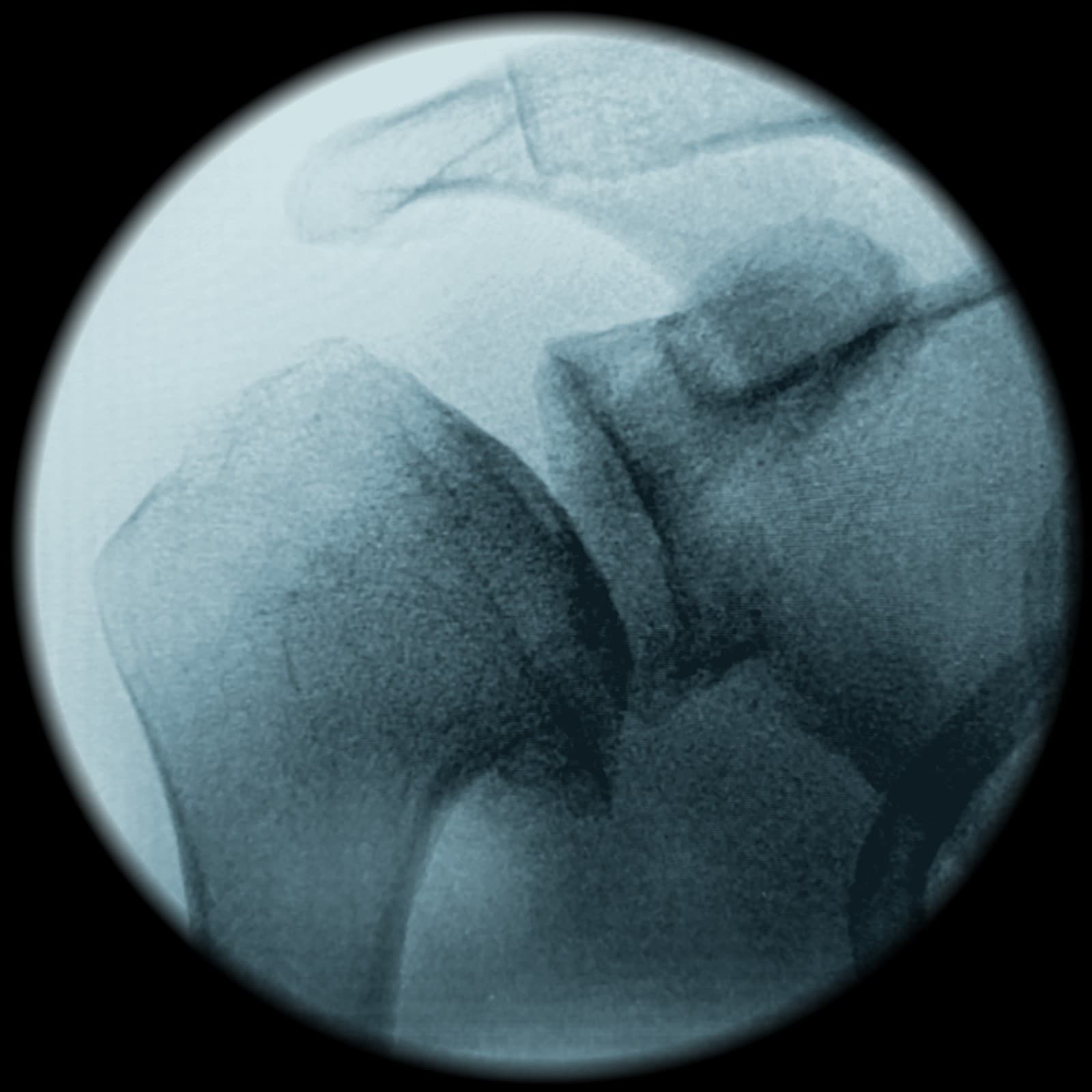
Arthroscopic Surgical Technique
Glenohumeral Osteoplasty Augmented Therapy (G.O.A.T.): Biological Augmentation for the Arthritic, Contracted Shoulder
For younger patients with glenohumeral osteoarthritis, arthroplasty carries a high revision risk. G.O.A.T. modifies the established comprehensive arthroscopic management procedure — pairing focused inferomedial osteoplasty and capsular release with a three-layer biological construct.
35–60
Candidate Age (yrs)
3-Layer
Biological Construct
2 mm
Min. Joint Space
Why This Technique Was Developed
A younger shoulder, a harder choice.
Glenohumeral osteoarthritis in younger patients is a recognised clinical problem. Total shoulder arthroplasty is the gold standard for end-stage disease, but in people under 65 it is associated with accelerated wear, glenoid loosening and a 3.4-fold higher revision risk. Arthroscopic joint preservation — chiefly the comprehensive arthroscopic management (CAM) procedure — relieves symptoms, yet its durability is variable because purely mechanical surgery leaves the joint’s hostile biological environment untreated.
Can a single arthroscopic procedure address both the mechanical deformity and the biologically adverse environment of the arthritic, contracted shoulder?
The three-layer biological construct
Marrow activation
Subchondral microfracture of full-thickness chondral defects with a dedicated awl — perforations at 3–4 mm intervals. Described as biologically plausible marrow stimulation, not validated cartilage restoration.
Collagen scaffold
A resorbable collagen matrix applied as a liquid that gels in situ, providing a temporary framework for cell retention. An extrapolated adjunct — no clinical studies have yet evaluated a collagen scaffold in the shoulder.
Micro-fragmented adipose tissue
Autologous mFAT injected as the final intra-articular step for paracrine signalling and immunomodulation by adipose-derived stromal cells — used as a biological adjunct, not a structural resurfacing agent.
How It Is Performed
One arthroscopy, in sequence.
The procedure is performed in the beach-chair position under general anaesthesia with an interscalene block, using standard posterior, accessory-posterior and anterior portals. The operative sequence moves from release, to mechanical reshaping, to biological support — the axillary nerve protected throughout by arm position and a disciplined burr trajectory.
Step 01
Inspect & release
Examination under anaesthesia and glenohumeral inspection, then stepwise capsular release — anterior first to gain external rotation, then posterior (10 to 6 o’clock) and inferior — to restore near-full passive motion.
Step 02
Focused osteoplasty
Through the accessory posterior portal a motorised burr removes the inferomedial “goat’s beard” osteophyte in a controlled, incremental fashion until a smooth inferior humeral contour is restored.
Step 03
Biological augmentation
Subchondral microfracture, then a resorbable collagen scaffold applied as a gelling liquid, then micro-fragmented adipose tissue injected last — because once introduced it obscures the arthroscopic view.
What Makes It Different
Mechanical repair, biological support.
G.O.A.T. keeps the proven mechanical core of CAM and adds four defining modifications — the most significant being a structured biological construct layered onto the decompressed joint.
Modification 01
Targeted inferomedial osteoplasty
Focused resection of the inferomedial humeral “goat’s beard” osteophyte with restoration of a smooth inferior humeral contour, eliminating the mechanical prominence that drives inferior capsular abutment.
Modification 02
Dual posterior portals
A standard posterior viewing portal plus an accessory posterior working portal give a direct posterior-to-inferomedial trajectory to the osteophyte — improving access to the calcar-adjacent region in the stiff, arthritic joint.
Modification 03
Reduced reliance on traction
Working space is created mainly through portal placement and stepwise capsular release rather than sustained traction, an approach tailored to the contracted glenohumeral joint.
Modification 04
Three-layer biological augmentation
Microfracture, a resorbable collagen scaffold and micro-fragmented adipose tissue are integrated within a single procedure to address the biologically adverse intra-articular environment that purely mechanical techniques leave untreated.
The evidence the rationale rests on
Each layer is justified by existing data — much of it from adjacent joints — rather than by outcomes of the combined technique, which have not yet been studied.
Evidence 01
Microfracture holds at a decade
A glenohumeral microfracture case series reported a 66.7% long-term success rate with significant patient-reported improvement at a mean 10.2-year follow-up — though the fibrocartilage it generates is mechanically inferior to native hyaline cartilage.
Evidence 02
mFAT benefit sustained to 36 months
In 65 patients with glenohumeral osteoarthritis, intra-articular mFAT improved Constant–Murley, visual analogue scale and simple shoulder test scores at 36 months, with an 83.08% satisfaction rate.
Evidence 03
CAM durability is variable
The comprehensive arthroscopic management procedure it builds on has a reported 10-year survival of about 63%, with conversion-to-arthroplasty rates across the literature ranging from 4% to 42.4% — the gap G.O.A.T. sets out to narrow.
Why It Matters Clinically
A route that keeps the joint.
For the younger, active patient facing end-stage shoulder arthritis, the choice has often been between a durable but revision-prone implant and a joint-preserving procedure whose benefit can fade. G.O.A.T. is framed as a middle path — treating the deformity mechanically while trying to shift the biology in the joint’s favour.
It is offered as a reproducible, clearly indicated technique — not a proven cure. Its value will be decided by the prospective studies its authors call for.
Joint-Preserving
Alternative
Offers younger patients a joint-preserving option where total shoulder arthroplasty carries a 3.4-fold higher revision risk under the age of 65.
Single-Stage
Procedure
Mechanical decompression and biological support are delivered in one arthroscopic sitting rather than staged across separate interventions.
Biological
Rationale
The construct targets the catabolic, interleukin-driven joint environment that impedes intrinsic repair — a dimension classic osteoplasty does not address.
Selective
Indication
A defined window — age 35–60, symptomatic despite ≥6 months of non-operative care, ≥2 mm joint space and preserved congruity — keeps the technique to patients most likely to benefit.
What This Study Does Not Show
A technique described, not yet proven.
A technique description, not an outcome study
This is a Technical Note. No clinical outcome data, complication rates or survivorship are reported — the evidence for each component is drawn from other joints and prior series, not from G.O.A.T. itself.
The combined construct is unvalidated
Each biological layer is individually supported, but the potential for additive benefit when all three are integrated in one procedure remains to be prospectively tested. The scaffold in particular is an extrapolated adjunct.
Added operative burden
The mFAT harvest requires an additional operative step that extends procedure time, and no evidence-based rehabilitation protocol exists for the combined biological augmentation — the described after-care is empirical.
Technique-specific thresholds
The 2 mm minimum joint-space criterion is a threshold chosen for this technique rather than an established standard, and the axillary nerve remains the principal structure at risk during inferomedial work.
The biological reasoning behind the construct sits alongside the group’s wider regenerative work — including the articular cartilage tissue-engineering review and the osteoporotic bone-scaffold review that map the scaffold and cell strategies it draws on.
Joint preservation, mechanically and biologically.
G.O.A.T. integrates focused inferomedial osteoplasty and capsular release with a three-layer biological construct in a single arthroscopic procedure — a plausible, reproducible strategy for the arthritic, contracted shoulder that now needs prospective outcome data.
Study Identity
- Authors:
- Sedeek Mosaid · Alun Yewlett · Charles Corbin · Paul Lee
- Institution:
- Department of Trauma and Orthopaedic Surgery, United Lincolnshire Teaching Hospitals NHS Trust, Lincoln
- Journal:
- SVOA Orthopaedics 2026;6(5):252–258
- Type:
- Technical Note — no clinical outcome data
- Funding:
- None declared
Citation
Mosaid S, Yewlett A, Corbin C, Lee P. Glenohumeral Osteoplasty Augmented Therapy (G.O.A.T.): A Novel Modification of the Comprehensive Arthroscopic Management Procedure Incorporating Biological Augmentation for the Arthritic, Contracted Shoulder. SVOA Orthop. 2026;6(5):252–258.
doi:10.58624/SVOAOR.2026.06.033 — open access under CC BY.
Funding and affiliations
Affiliations: Department of Trauma and Orthopaedic Surgery, United Lincolnshire Teaching Hospitals NHS Trust, Lincoln
Funding: None declared